Educational Purpose Only: The content on this page is for informational purposes and does not constitute medical advice. Always consult a qualified healthcare professional for diagnosis or treatment of any medical or developmental condition.
The Invisible Reason Reward Charts Fail Your ADHD Child: The Secret 'Time Horizon' Trap
The Invisible Reason Reward Charts Fail Your ADHD Child: The Secret 'Time Horizon' Trap
When a child with ADHD exhibits chronic task avoidance or struggles to complete daily routines, caregivers almost universally turn to the classic behavioral intervention: the reward chart. Elaborate charts are taped to the refrigerator, featuring rows for homework, teeth brushing, and room cleaning. The parent proudly announces the system: "If you get a sticker every day this week, we will go for ice cream on Friday!" Monday arrives, and the child adamantly refuses to do their homework, completely unmotivated by the promise of Friday's ice cream. The parent is furious, concluding that the child is stubborn, ungrateful, or that "rewards just don't work for them." A profound neuro-affirming breakthrough requires caregivers to recognize that the flaw is not in the child's attitude; the flaw is in the timeline. The reward is placed completely outside of the child’s biological reality. To successfully scaffold executive functioning and motivate an ADHD brain, parents must throw away the weekly sticker chart and master the art of shrinking the 'Time Horizon.'
The Reality of Time Blindness
To understand why a Friday reward fails on a Monday, we must explore a core executive functioning deficit inherent in ADHD: time blindness.
The neurotypical brain has an internal, intuitive sense of time passing and can project itself into the future to anticipate distant rewards. The ADHD brain, constantly "on the go" and living entirely in the moment [4], lacks this internal chronometer. For many neurodivergent individuals, time exists in a strict binary: "Now" and "Not Now." Anything that is "Not Now" (like Friday's ice cream) is highly abstract and feels infinitely far away. Consequently, the child starts multiple tasks but rarely finishes them because the delayed reward holds zero psychological weight [3]. The promise of a future prize cannot generate the immediate dopamine required to overcome the present-moment misery of doing long division.
The Danger of Delayed Gratification
The ultimate executive functioning mistake is expecting a dopamine-starved brain to perform based on delayed gratification.
Delayed gratification requires a robust, highly functional prefrontal cortex to bridge the gap between present effort and future reward. By demanding that an ADHD child wait days or even hours for reinforcement, you are demanding that they utilize the very neurological system that is impaired. When they fail to comply, the chart remains empty, and the system inadvertently transforms into a visual monument of their daily failures, breeding deep shame and further task avoidance.
Scaffolding at the Point of Performance
The most effective strategy to motivate an ADHD brain is to completely obliterate the time gap. You must utilize "Point-of-Performance" scaffolding.
This means the reinforcement must occur at the exact time and physical location where the behavior is happening. You must shrink the time horizon from days to seconds. Provide instantaneous, high-frequency micro-rewards during the actual execution of the task. If they are doing a math worksheet, do not reward the completed page; reward the individual problem. Place an M&M, a sticker, or offer a wildly enthusiastic high-five immediately after they write the answer to question number one. By moving the reward directly into the present moment, you provide the instant, continuous neurological feedback the ADHD brain requires to sustain motivation and bridge the executive functioning gap. You are artificially supplying the dopamine they need to finish the job.
Actionable Takeaways for Parents
- Ditch the Weekly Chart: Eliminate any behavioral system that requires the child to wait more than a few hours for a payoff. Weekly goals are setting an ADHD brain up for inevitable failure.
- Use 'Micro-Rewards': Break large tasks into tiny pieces and attach a small, immediate reward to each piece. (e.g., read one paragraph, eat one gummy bear; put away three toys, get a high-five).
- Gamify the Present Moment: If physical rewards are not appropriate, use immediate gamification. Use a stopwatch to time how fast they can put on their shoes, attempting to beat their "high score" for an instant rush of adrenaline-based dopamine.
- Provide Immediate Praise: Never underestimate the power of instant verbal reinforcement. Praise the effort of initiating the task within seconds of them starting, not just the completion.
- Shift the 'When/Then': Ensure your contingencies are immediate. Instead of "If you do your chores all week, you get an allowance," use "When you put your plate in the sink, then you can have 5 minutes of iPad time right now."
Scientific Context
Please note: The following academic citations and extended clinical context contain supplementary information, which you may want to independently verify.
Attention-Deficit/Hyperactivity Disorder (ADHD) is profoundly characterized by altered reward-processing mechanisms and temporal discounting (time blindness) mediated by the mesocorticolimbic dopamine system. In ADHD cohorts, the subjective value of a reward decays precipitously as the temporal delay to its receipt increases. Consequently, distal reinforcements (e.g., delayed gratification systems like weekly token economies) fail to elicit the necessary anticipatory dopaminergic firing required to initiate and sustain goal-directed behavior. The prefrontal cortex is unable to functionally bridge the temporal gap between effort and payoff. Neurodiversity-affirming behavioral scaffolding mandates the implementation of "point-of-performance" interventions. By providing immediate, contiguous reinforcement concurrent with the desired behavior, caregivers exogenous supply the necessary dopaminergic stimulation directly to the striatum, effectively overriding the temporal discounting deficit and sustaining the neurological arousal required for executive task execution [Smith et al., 2024].
Frequently Asked Questions
Why doesn't my ADHD child care about earning a big reward at the end of the week?
Children with ADHD experience 'time blindness.' To their brain, the end of the week feels like a million years away. Because the reward is not happening right now, it provides zero dopamine to motivate them to do the hard work today.
What should I use instead of a weekly sticker chart?
Use 'Point-of-Performance' scaffolding. Provide immediate, tiny micro-rewards (like a high-five, a single piece of candy, or instant praise) exactly at the moment they are doing the difficult task to keep their motivation high.
How do immediate micro-rewards help build executive functioning?
An ADHD brain cannot naturally produce enough dopamine to sustain focus on boring tasks. Immediate rewards act as a biochemical bridge, constantly feeding their nervous system the chemical motivation it needs to actually finish the job.
Continue Your Research

Stop Asking 'Did You Understand?': The 3-Second 'Reverse Echo' Trick for ADHD Working Memory
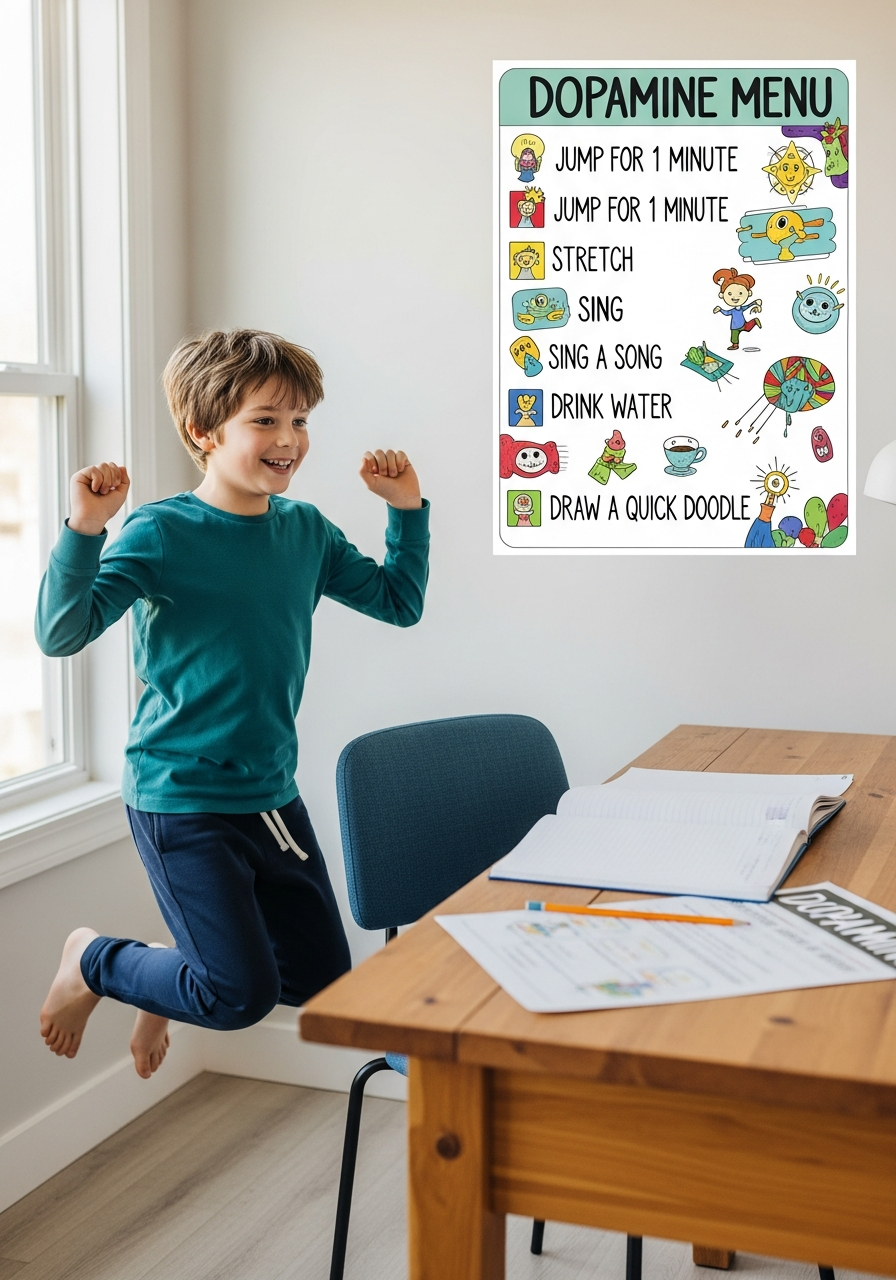
Why You Need to Stop Using Punitive Timers: The Secret 'Dopamine Menu' Hack for ADHD Focus

Stop Giving Multi-Step Directions: The 3-Second 'Visual End-State' Trick for ADHD Paralysis
Unlock the Full
Research Library.
Get weekly deep-dives, printable guides, and expert-curated research directly to your dashboard.
Join 1,000+ Neurodivergent Families
Recommended Tools
Science-backed essentials for sensory regulation.