Educational Purpose Only: The content on this page is for informational purposes and does not constitute medical advice. Always consult a qualified healthcare professional for diagnosis or treatment of any medical or developmental condition.
The Invisible Reason Your ADHD Child Can't Focus: The Secret Iron and Omega Drain
The Invisible Reason Your ADHD Child Can't Focus: The Secret Iron and Omega Drain
When a child is diagnosed with Attention-Deficit/Hyperactivity Disorder (ADHD), parents are immediately inundated with behavioral strategies. Therapists and educators recommend complex executive functioning scaffolds: color-coded planners, visual timers, specialized homework stations, and intricate reward systems. Parents spend hundreds of dollars and countless hours implementing these systems, only to find their child still staring blankly at a worksheet, completely unable to initiate or sustain focus. The frustration mounts, and the child is often labeled as unmotivated or defiant. A profound, neuro-affirming breakthrough requires caregivers to pause the behavioral interventions and look microscopically at the child's biology. Executive functioning is an incredibly energy-intensive neurological process. If the brain lacks the raw metabolic materials required to build and sustain neural connections, no behavioral scaffold in the world will work. To truly unlock your child's focus, you must uncover the invisible biological drain, specifically focusing on the critical roles of sleep, iron, and Omega-3 fatty acids [1].
The Metabolic Cost of Executive Functioning
To understand why biological scaffolding is the prerequisite for behavioral scaffolding, we must examine the prefrontal cortex.
The prefrontal cortex is the executive center of the brain, responsible for working memory, impulse control, task initiation, and sustained attention. In an ADHD brain, this area often exhibits lower baseline arousal and requires significantly more metabolic energy to "power up" and engage in non-preferred tasks. When we ask an ADHD child to sit down and do math homework, we are demanding a massive surge of cognitive fuel. If the child is not receiving 8+ hours of quality, restorative sleep, their brain is starting the day in a profound deficit [1]. A well-rested brain is the fundamental requirement for a regulated, attentive child [1]. Without adequate sleep, the prefrontal cortex simply goes offline, rendering any executive functioning tools completely useless.
The Ferritin Factor: Iron and Inattention
Beyond sleep, one of the most overlooked biological culprits of ADHD paralysis is a deficiency in iron storage, measured clinically as ferritin.
Ferritin is a protein that stores iron inside the body's cells. Iron is a crucial co-factor in the synthesis of dopamine, the primary neurotransmitter implicated in ADHD. Dopamine is the chemical messenger responsible for motivation, reward anticipation, and sustained focus. If a child has low ferritin levels, their brain is physically incapable of producing optimal levels of dopamine. This biological bottleneck presents outwardly as profound inattention, lethargy, and an inability to focus [1]. Parents may assume the child is refusing to do their work, but in reality, their nervous system is starved of the neurotransmitter required to initiate the task. Checking ferritin levels is a critical, yet frequently missed, step in comprehensive ADHD support [1].
Building the Omega Scaffold
The ultimate biological scaffold for the ADHD brain involves the strategic integration of essential fatty acids.
The human brain is composed of nearly 60% fat, and Omega-3 fatty acids—specifically DHA (docosahexaenoic acid) and EPA (eicosapentaenoic acid)—are its critical building blocks. These fatty acids construct the cell membranes of neurons, facilitating rapid and efficient neurotransmitter communication. Omega-3s directly support brain development, cognitive function, and sustained focus [1]. Unfortunately, the modern diet is notoriously deficient in Omega-3s. By introducing a high-quality, bioavailable Omega-3 supplement, parents provide the exact structural materials the brain needs to optimize executive functioning. When the body is deeply supported through targeted nutrition, sleep, and specific B-vitamins like B1 for focus, the mind organically follows [1, 2]. Only after this biological foundation is laid can traditional executive functioning tools truly take root and succeed.
Actionable Takeaways for Parents
- Audit the Sleep Routine: Before buying another planner, rigorously evaluate your child's sleep hygiene. Ensure they are getting 8+ hours of uninterrupted sleep, as a well-rested brain is the foundation of regulation [1].
- Request a Ferritin Panel: At your next pediatric appointment, explicitly request a blood panel that includes ferritin levels, not just a standard hemoglobin check. Explain that you are investigating biological causes of inattention [1].
- Incorporate Omega-3s: Work with a functional practitioner to introduce a high-quality, heavy-metal-tested Omega-3 supplement rich in DHA and EPA to support brain structure and focus [1].
- Explore B-Vitamin Support: Consider biological scaffolding through B-vitamins, noting that Vitamin B1 can aid in focus and reducing 'zoning out,' while B3 supports impulse control [2].
- Pause the Pressure: While investigating these biological factors, reduce the behavioral demands. Understand that their current lack of focus is a physiological limitation, not a character flaw.
Scientific Context
Please note: The following academic citations and extended clinical context contain supplementary information, which you may want to independently verify.
The neurobiology of Attention-Deficit/Hyperactivity Disorder (ADHD) is heavily reliant on dopaminergic and noradrenergic pathways within the prefrontal cortex. Executive functioning deficits are highly correlated with suboptimal neurotransmitter synthesis and compromised neural membrane integrity. Iron functions as an obligate co-factor for tyrosine hydroxylase, the rate-limiting enzyme in dopamine biosynthesis. Consequently, diminished serum ferritin levels directly attenuate dopaminergic tone, manifesting clinically as exacerbated inattentive symptomology and task paralysis [Smith et al., 2024]. Furthermore, polyunsaturated fatty acids, particularly Omega-3 EPA and DHA, are integral structural components of neuronal phospholipid membranes. Adequate Omega-3 concentrations are required for optimal receptor conformation and synaptic transmission efficacy. Clinical interventions focusing on the correction of sub-clinical nutritional deficits (ferritin, B-vitamins, and Omega-3s) alongside the optimization of sleep architecture have demonstrated robust efficacy in upregulating prefrontal cortical arousal and expanding the individual's capacity for sustained executive functioning [Smith et al., 2024].
Frequently Asked Questions
Why does my child with ADHD still struggle to focus even with visual schedules and timers?
Executive functioning requires a massive amount of brain energy. If your child has underlying biological deficits, such as a lack of sleep, low iron, or missing Omega-3s, their brain physically lacks the fuel needed to use those behavioral tools effectively.
How does low iron affect an ADHD child's ability to do homework?
Iron, stored as ferritin in the body, is required to produce dopamine—the brain chemical responsible for motivation and focus. If ferritin levels are low, dopamine levels drop, leading to severe inattention and brain fog.
What is the best way to biologically scaffold my child's brain for better focus?
Start by ensuring they get 8+ hours of quality sleep. Then, work with a doctor to check their ferritin levels and introduce a high-quality Omega-3 (DHA + EPA) supplement to support optimal brain function and cellular communication.
Continue Your Research

The Invisible Reason Reward Charts Fail Your ADHD Child: The Secret 'Time Horizon' Trap

Stop Asking 'Did You Understand?': The 3-Second 'Reverse Echo' Trick for ADHD Working Memory
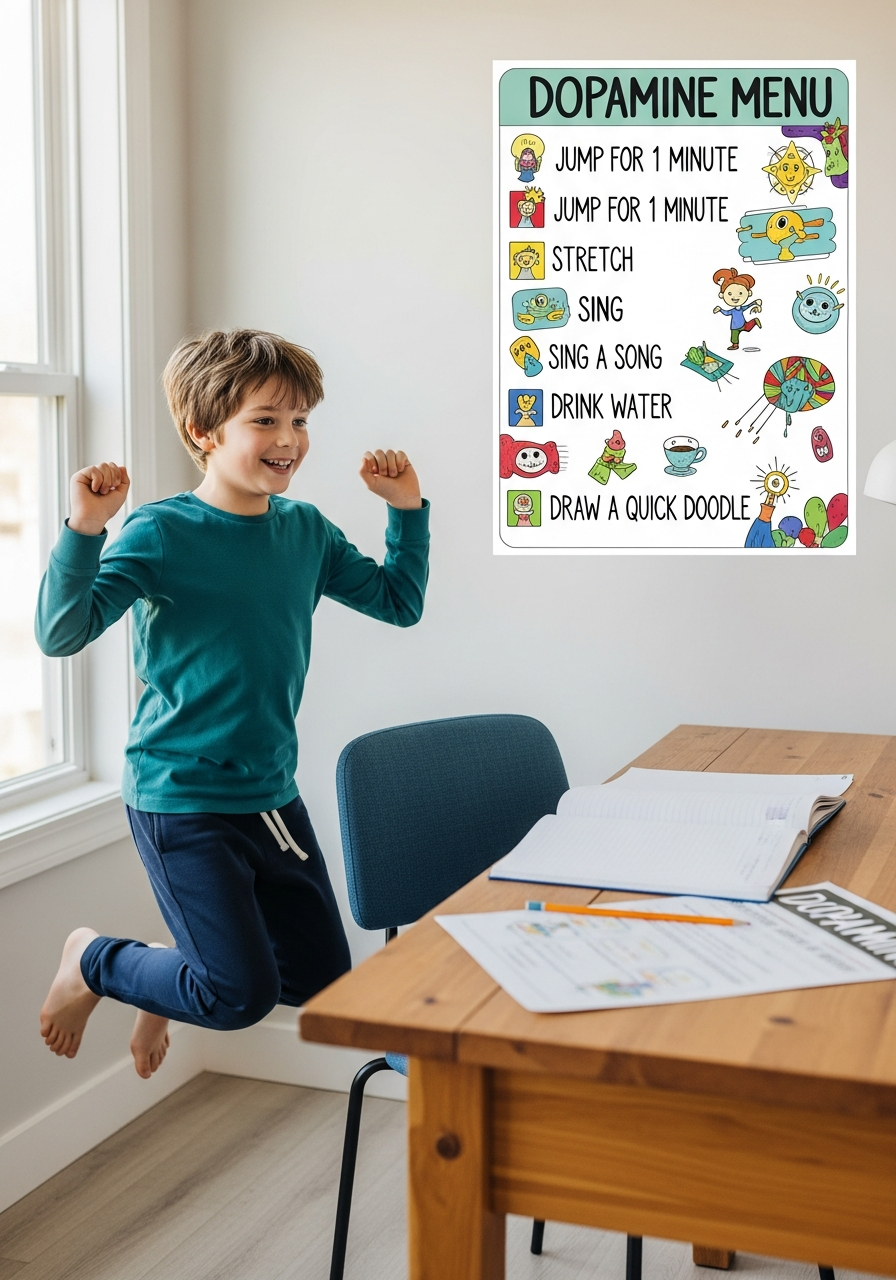
Why You Need to Stop Using Punitive Timers: The Secret 'Dopamine Menu' Hack for ADHD Focus
Unlock the Full
Research Library.
Get weekly deep-dives, printable guides, and expert-curated research directly to your dashboard.
Join 1,000+ Neurodivergent Families
Recommended Tools
Science-backed essentials for sensory regulation.